Legal Insights
Legal Insights
Artificial Intelligence and the Law in Nepal: Emerging Legal Risks and What Businesses Should Prepare For
2026-05-17
Admin
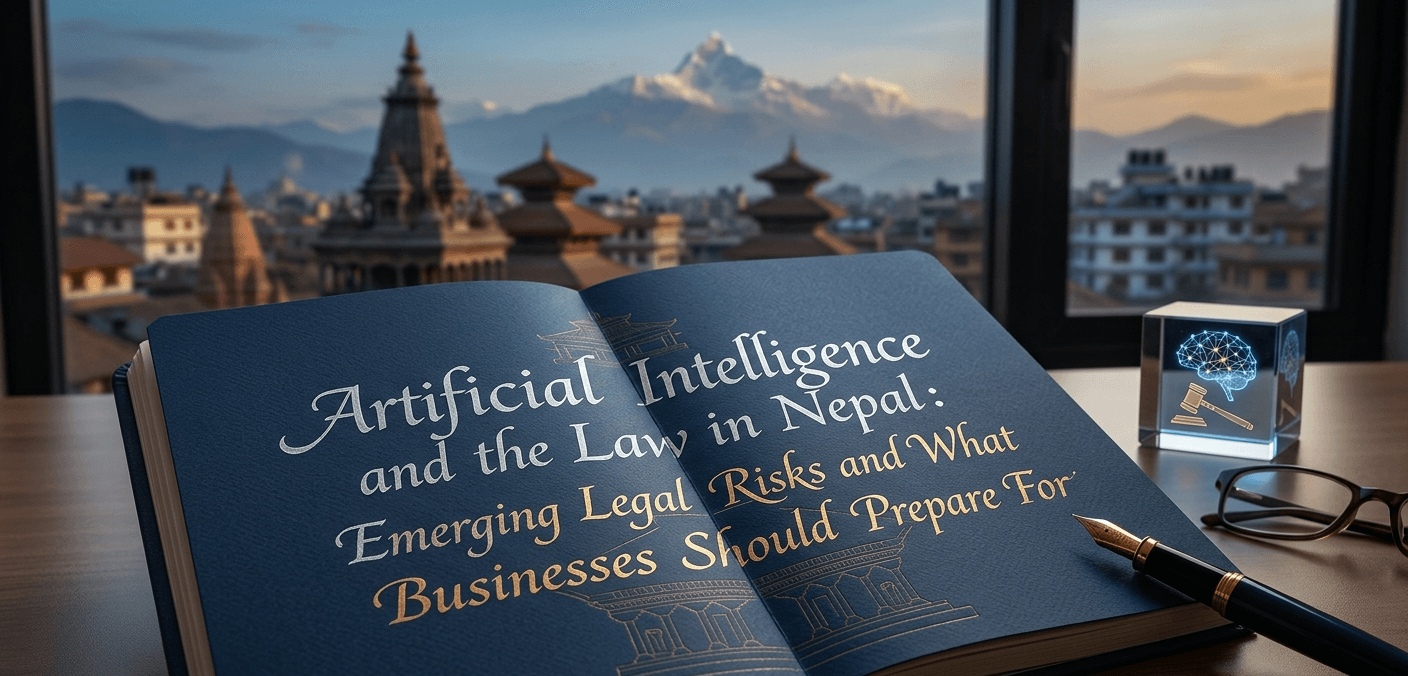
Artificial Intelligence (AI) is rapidly transforming industries in Nepal from banking and fintech to education, healthcare, legal services, and e-commerce. Businesses are increasingly using AI for automation, customer service chatbots, fraud detection, data analysis, and decision-making systems.
However, while AI brings efficiency and innovation, it also introduces serious legal, ethical, and regulatory risks. Nepal currently does not have a standalone AI law, but several existing legal frameworks regulate its use indirectly.
This article explains the legal landscape of AI in Nepal, key risks, applicable laws, and what businesses should prepare for in the coming regulatory environment.
Artificial Intelligence refers to systems that can:
Learn from data
Make predictions or decisions
Perform tasks that typically require human intelligence
In legal and business contexts, AI is used for:
Automated decision-making
Chatbots and virtual assistants
Financial risk assessment
Facial recognition systems
Content generation tools
Nepal does not yet have a dedicated AI law or AI regulatory framework.
Instead, AI-related issues are governed indirectly through existing laws such as:
Electronic Transactions Act, 2063 (Nepal)
Privacy Act, 2074 (Nepal)
Copyright Act, 2059 (Nepal)
Consumer Protection Act, 2074 (Nepal)
Muluki Civil Code, 2073 (Nepal)
These laws are being applied to digital systems, including AI-based tools.
AI systems often rely on large datasets, including personal information.
Risks include:
Unauthorized data collection
Lack of user consent
Data misuse or leakage
Profiling without transparency
Under the Privacy Act, 2018 (Nepal), misuse of personal data can lead to legal consequences.
AI systems may produce biased outcomes due to:
Poor training data
Lack of diversity in datasets
Faulty algorithms
This can lead to unfair:
Hiring decisions
Loan approvals
Insurance assessments
Such discrimination may violate principles under civil law and consumer protection frameworks.
A major legal question is:
Who is responsible when AI makes a mistake?
Possible responsible parties:
Developer
Company using AI
Service provider
Data handler
Nepal’s current laws do not clearly define AI liability, creating legal uncertainty.
AI raises copyright challenges such as:
Who owns AI-generated content?
Can AI training data violate copyright?
Is AI output protected under copyright law?
The Copyright Act, 2002 (Nepal) does not yet fully address AI-generated works.
AI-based services may mislead or harm consumers.
Examples:
Incorrect chatbot advice
Faulty financial predictions
Misleading product recommendations
Under the Consumer Protection Act, 2018 (Nepal), businesses must ensure fairness and transparency.
AI systems can be targeted by:
Data breaches
Model manipulation (adversarial attacks)
System hacking
This also connects to obligations under the Electronic Transactions Act, 2063 (Nepal).
Nepal currently lacks:
AI-specific legislation
Clear rules on automated decision-making
Defined liability frameworks
AI ethics guidelines at national level
This creates uncertainty for businesses adopting AI technologies.
Even without AI-specific law, current statutes still apply:
Regulates digital systems, cybersecurity, and electronic records.
Protects personal data used by AI systems.
Ensures fairness in AI-driven services.
Covers AI-generated content and training data disputes.
Nepal is expected to gradually move toward:
Digital governance frameworks
Data protection reforms
AI ethics guidelines
Stricter cybersecurity laws
Global developments (EU AI Act, India’s digital policies) may also influence Nepal’s future laws.
Businesses should:
Collect only necessary data
Obtain user consent
Secure databases
Companies should disclose:
When users are interacting with AI
How decisions are made
Establish internal policies for:
AI usage
Human oversight
Error correction
Implement:
Encryption
Access control
Regular audits
Businesses should prepare:
AI usage policies
Privacy policies
Terms of service
Credit scoring errors
Fraud detection failures
Misdiagnosis risks
Data privacy issues
Biased recommendation systems
False pricing or product suggestions
Incorrect AI-generated legal advice
Because Nepal lacks specific AI legislation:
Courts may rely on general civil liability rules
Businesses may be held responsible for AI errors
Contracts become very important in risk allocation
Use AI as a support tool, not sole decision-maker
Keep human oversight in critical systems
Maintain audit logs of AI decisions
Regularly test algorithms for bias
Stay updated with legal reforms
Nepal is expected to gradually introduce:
AI governance policies
Data protection legislation updates
Digital ethics frameworks
Sector-specific AI regulations
This will align Nepal with global digital transformation trends.
Artificial Intelligence is reshaping business operations in Nepal, but legal systems are still evolving to keep up. While there is no dedicated AI law yet, multiple existing laws such as the Electronic Transactions Act, 2063 (Nepal), Privacy Act, 2073 (Nepal), and Consumer Protection Act, 2073 (Nepal) play a crucial role in regulating AI-related risks.
Businesses must proactively manage compliance, ensure transparency, and prepare for upcoming regulations to safely integrate AI into their operations.
No, Nepal does not yet have a specific AI law.
Mainly the Electronic Transactions Act, Privacy Act, and Consumer Protection Act.
Currently, responsibility depends on the company or developer using the AI system.
Nepal law is not yet clear on this issue.