
Legal Insights
Legal Insights
Divorce by Mutual Consent in Nepal: Legal Procedure, Timeline & Documents Required
2026-05-12
Admin
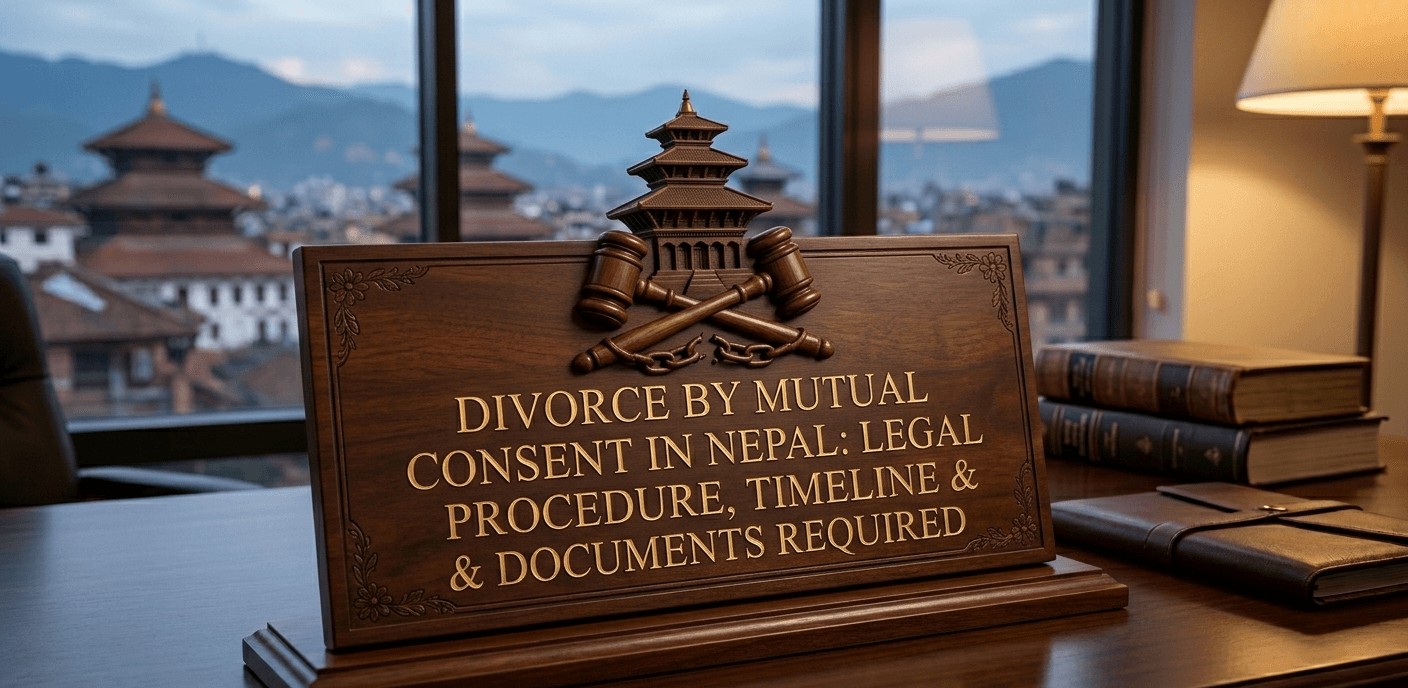
Divorce is never an easy decision, but when both spouses agree to separate amicably, the legal process becomes significantly simpler. In Nepal, divorce by mutual consent is the most straightforward and least confrontational method of ending a marriage.
The process is governed by the Muluki Civil Code, 2017 (Nepal), which recognizes the right of both husband and wife to dissolve their marriage voluntarily through mutual agreement.
Divorce by mutual consent is a legal process where both husband and wife agree to end their marriage voluntarily without blaming each other or engaging in a contested court battle.
Unlike contested divorce, this method is:
Faster
Less expensive
Less emotionally stressful
Legally simpler
Mutual divorce is recognized under the Muluki Civil Code, 2017 (Nepal), which allows both spouses to jointly file for divorce if they agree to separate and settle related matters such as property division and child custody.
Couples can apply for mutual divorce if:
Both spouses agree to divorce
Marriage is legally registered
Both parties are mentally sound and consenting
Property and financial matters are mutually settled or agreed upon
Arrangements for children (if any) are agreed
Both husband and wife must file a joint divorce petition at the concerned District Court.
The petition includes:
Consent of both parties
Reason for separation (optional in mutual divorce)
Agreement on property and children
Required documents are submitted along with the petition (see section below).
The court:
Verifies documents
Checks mutual consent
May attempt reconciliation (if required)
In some cases, the court may give time for reconciliation to ensure the decision is final and voluntary.
If both parties still agree:
Court records statements
Confirms consent
Approves divorce
The court issues a final divorce decree, officially dissolving the marriage.
You typically need:
Citizenship certificates of both spouses
Marriage registration certificate
Joint divorce petition
Passport-size photos
Agreement on property division (if applicable)
Child custody agreement (if children are involved)
Proof of residence (if required by court)
The duration depends on court workload and case complexity, but generally:
Simple cases: 1 to 3 months
Cases with property/child agreements: 3 to 6 months
Mutual consent divorce is significantly faster than contested divorce, which may take years.
Couples must mutually decide:
Division of movable and immovable property
Bank accounts and savings
Loans or liabilities
If agreement is not reached, the court may intervene based on fairness principles under the Muluki Civil Code, 2017 (Nepal).
If the couple has children, they must agree on:
Custody (mother, father, or joint arrangement)
Child support (maintenance)
Education and healthcare responsibilities
The court prioritizes the best interest of the child.
Faster legal process
Lower legal costs
Less emotional conflict
No need for proving fault
More control over settlement terms
Requires full agreement between spouses
Emotional difficulty despite cooperation
Potential disputes over property or children
Court may still require clarification or reconciliation attempts
Not documenting property agreements properly
Ignoring child custody arrangements
Filing incomplete documents
Assuming verbal agreements are enough
Delaying legal filing unnecessarily
Divorce by mutual consent in Nepal is the most practical and peaceful way to end a marriage when both parties agree. Guided by the Muluki Civil Code, 2017 (Nepal), the process ensures fairness while reducing emotional and financial burden.
By preparing the required documents, clearly settling property and custody matters, and following court procedures, couples can complete the process smoothly and respectfully.
It usually takes 1 to 3 months, depending on court workload and case complexity.
No. Even mutual consent divorce must be finalized through the District Court under the Muluki Civil Code, 2017 (Nepal).
Yes, both spouses must be present during filing and final hearing.
Yes, but the agreement should be documented and submitted to the court for legal validity.