
Legal Insights
Legal Insights
How Courts Decide Child Custody Cases in Nepal Key Legal Factors
2026-05-06
Admin
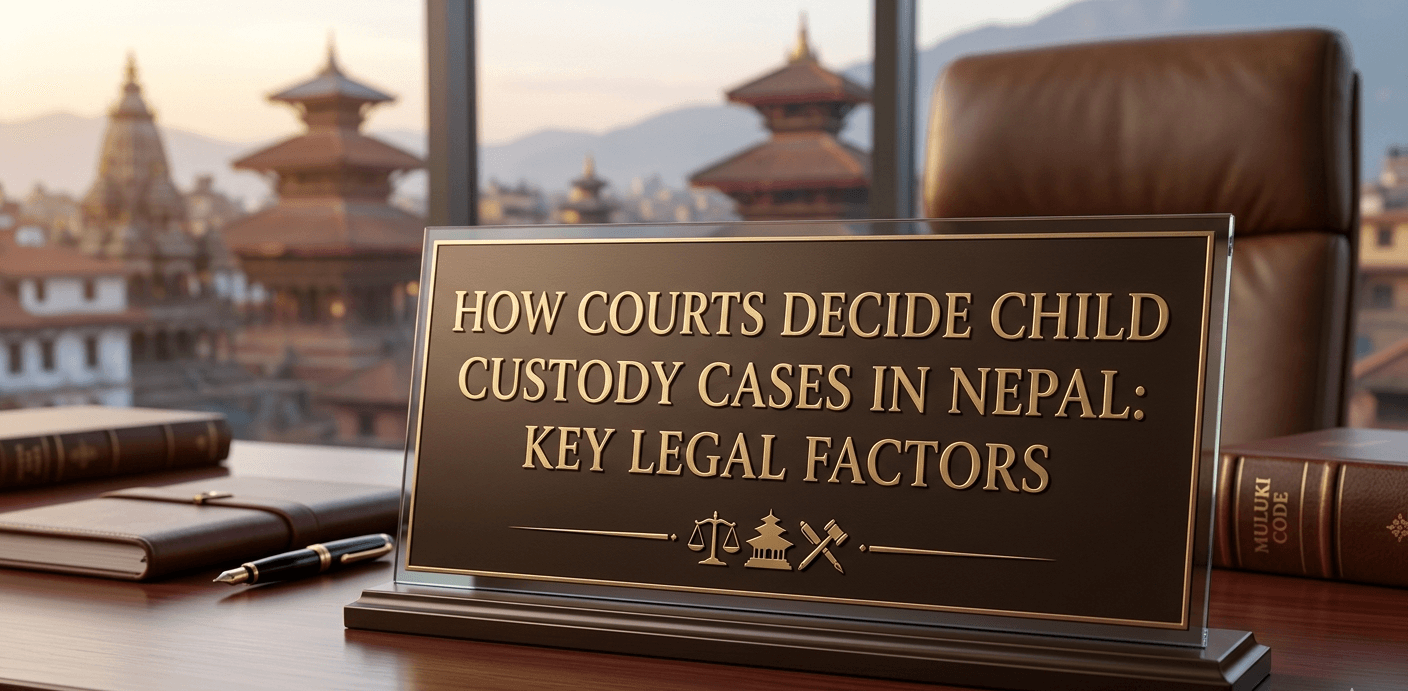
Child custody cases are among the most sensitive matters handled by courts in Nepal. When parents separate or divorce, deciding who will take care of the child becomes a critical legal and emotional issue. The primary focus of Nepalese courts is not the rights of the parents, but the best interest and welfare of the child.
In Nepal, child custody decisions are guided mainly by the Muluki Civil Code, 2017 (2074 BS) and related family law provisions. Courts carefully evaluate several factors before granting custody to either parent.
This guide explains how courts decide child custody cases in Nepal, the legal factors involved, and what parents should expect during the process.
Child custody refers to the legal right and responsibility of a parent or guardian to take care of a child after separation or divorce. It includes:
Physical care of the child
Education and upbringing
Health and welfare decisions
Day-to-day responsibility
In Nepal, custody is not automatically given to either parent. It is decided by the court based on evidence and circumstances.
Child custody matters in Nepal are governed by:
Muluki Civil Code, 2017 (2074 BS)
Family law provisions under Nepalese civil law
Judicial interpretations by Nepalese courts
The law emphasizes that custody decisions must prioritize the best interest of the child, not parental preference.
The most important rule in child custody cases in Nepal is the best interest of the child principle.
Courts consider:
Emotional well-being
Financial stability
Education and development
Safety and living environment
The goal is to ensure the child grows up in a stable and supportive environment.
Age plays a major role in custody decisions:
Young children (especially below 5–7 years) are often placed with the mother
Older children may be asked about their preference
Teenagers’ opinions are given more importance
However, age alone is not the final deciding factor.
Courts evaluate which parent can better provide for the child’s needs:
Income level
Job stability
Ability to support education and healthcare
A financially stable parent is more likely to be granted custody, but financial status alone is not decisive.
The court considers:
Who the child is more attached to
Who has been the primary caregiver
Emotional support provided by each parent
Maintaining emotional stability is a key priority.
The court examines the living conditions offered by each parent:
Safety of the home
Access to education
Stability of environment
Presence of extended family support
A stable and safe environment is crucial for custody decisions.
Courts assess the behavior and lifestyle of each parent:
History of abuse or neglect
Criminal background
Addiction issues
Moral conduct
A parent with a stable and responsible lifestyle has a better chance of gaining custody.
If the child is mature enough, the court may consider their opinion. However:
The child’s preference is not binding
It is only one of many factors
Courts also look at:
Schooling opportunities
Daily care arrangements
Time availability of the parent
The parent who can provide better overall development support is favored.
If the child has medical conditions or special needs, the court considers:
Who can provide better medical care
Accessibility to treatment facilities
Emotional and physical support
In Nepal:
Mothers are often preferred for younger children
Fathers may be granted custody if they provide better welfare
Joint custody is not commonly practiced but may be considered in some cases
Each case is decided individually based on circumstances.
Even if one parent gets custody, the other parent is usually required to provide child maintenance, which may include:
Education expenses
Healthcare costs
Daily living expenses
The amount is decided based on income and financial capacity.
One parent files a custody case in the District Court.
Required documents include:
Marriage certificate
Child’s birth certificate
Financial proof
Supporting evidence
Both parents present their arguments and evidence.
The court may investigate living conditions and background.
The court issues a custody order based on the child’s best interest.
Parents often face:
Emotional stress
Long legal procedures
Disputes over visitation rights
Financial disagreements
Lack of awareness about legal rights
Legal guidance can help simplify the process.
Focus on the child’s welfare, not personal conflict
Maintain proper documentation
Avoid negative behavior in court
Ensure stable income and living conditions
Seek legal advice for better preparation
Child custody cases in Nepal are decided based on a careful evaluation of multiple factors, with the best interest of the child being the most important principle. Courts consider financial stability, emotional bonds, living conditions, parental behavior, and the child’s needs before making a final decision.
Understanding these legal factors helps parents prepare better and ensures that decisions are made in a way that supports the child’s future well-being. In all cases, the law aims to protect children and provide them with a safe, stable, and nurturing environment.
There is no fixed rule, but mothers are often preferred for younger children unless circumstances suggest otherwise.
Yes, if the court finds that the father can better provide for the child’s welfare.
Yes, if the child is mature enough, but it is not the only deciding factor.
Yes, the non-custodial parent usually pays child maintenance.
Yes, custody orders can be modified if circumstances change.