
Legal Insights
Legal Insights
How to File for Divorce in Nepal: Legal Process & Rights Explained
2026-04-27
Admin
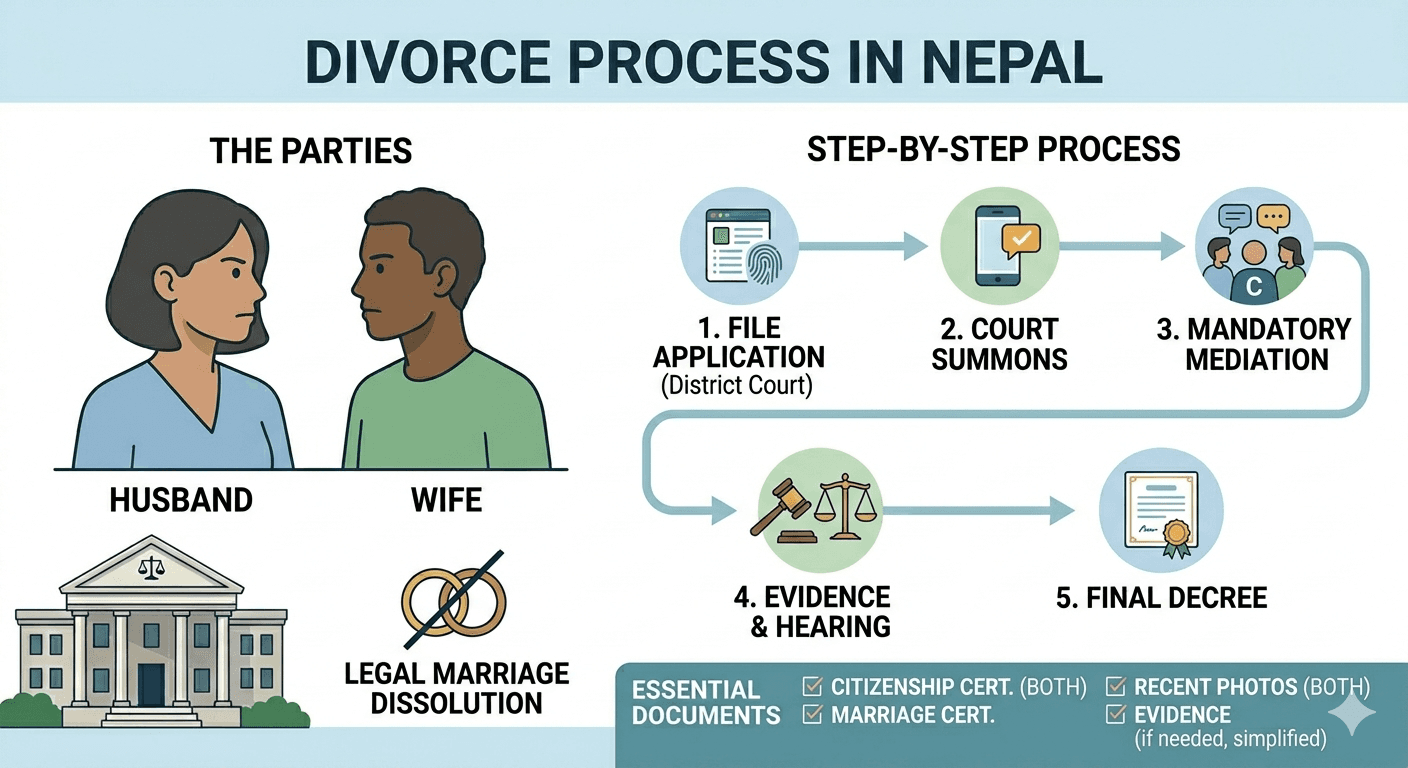
Divorce is a significant legal and personal decision that affects not only the couple but also their families. In Nepal, the process of divorce is governed by the Muluki Civil Code 2074, which outlines the rights, responsibilities, and procedures for ending a marriage legally.
Understanding the divorce process in Nepal, along with your legal rights and obligations, is essential for ensuring a smooth and fair resolution. Whether you are considering filing for divorce or simply seeking information, this guide provides a complete overview of the legal framework and steps involved.
Divorce and Separation in Nepal is legally recognized as the formal termination of a marriage through a court process. Both husbands and wives have the right to file for divorce under specific conditions defined by law.
The legal system in Nepal aims to ensure fairness, protect individual rights, and provide solutions for issues such as property division, child custody, and financial support.
Before filing for divorce, it is important to understand the legally accepted grounds.
A husband may file for divorce if:
The wife has been living separately for a certain period without consent
The wife denies marital relations without valid reason
The wife commits infidelity
The wife engages in behavior that causes serious harm or mental distress
A wife may file for divorce if:
The husband marries another woman
The husband abandons or neglects her
The husband commits domestic violence or abuse
The husband fails to provide financial support
The husband engages in extramarital relationships
These grounds ensure that both parties have equal rights to seek divorce under fair conditions.
Both spouses agree to end the marriage
Faster and less complicated process
Requires joint application in court
One spouse files against the other
Requires legal proof and court hearings
May take longer due to disputes
Choosing the right type of divorce depends on the agreement and situation between the spouses.
Understanding the legal process for divorce helps avoid confusion and delays.
Seek legal advice to understand your rights and options
Prepare necessary documents and strategy
Submit a divorce application to the District Court
Include reasons for divorce and supporting documents
The court notifies the other party
The respondent has the opportunity to reply
The court may attempt reconciliation through mediation
If mediation fails, the case proceeds further
Both parties present evidence and arguments
The judge reviews all aspects of the case
The court issues a divorce decree
Legal separation becomes official
To file for divorce, the following documents are generally required:
Marriage registration certificate
Citizenship certificates of both spouses
Proof of residence
Evidence supporting the grounds for divorce
Photographs and other relevant documents
Proper documentation is essential for a smooth legal process.
One of the most sensitive aspects of divorce is child custody. Nepalese law prioritizes the best interests of the child.
Custody may be granted to either parent based on the child’s welfare
The non-custodial parent may have visitation rights
Financial support (child maintenance) is determined by the court
Parents are encouraged to reach an agreement, but the court makes the final decision if disputes arise.
Divorce also involves the division of property and financial responsibilities.
Property acquired during marriage may be divided between spouses
The wife may have rights to property or financial support depending on the situation
Alimony or maintenance may be granted based on need and financial capacity
Understanding your financial rights is crucial for a fair settlement.
The duration of the divorce process depends on the type of case:
Mutual Divorce – Usually faster, may take a few months
Contested Divorce – Can take several months to years depending on complexity
Proper legal guidance can help speed up the process and reduce delays.
Divorce cases in Nepal may involve challenges such as:
Emotional stress and family pressure
Disputes over child custody
Property and financial disagreements
Delays in court proceedings
Lack of proper legal knowledge
Professional legal assistance helps address these challenges effectively.
A qualified lawyer plays a crucial role in ensuring a smooth divorce process.
Benefits include:
Expert guidance on legal rights and procedures
Proper preparation and filing of documents
Strong representation in court
Assistance in negotiation and settlement
Protection of your interests
Legal support reduces stress and ensures that your case is handled professionally.
To make the process easier, consider the following tips:
Understand your legal rights clearly
Keep all necessary documents ready
Try mutual agreement if possible
Stay calm and avoid unnecessary conflicts
Seek professional legal advice
These steps can help simplify the process and reduce complications.
Filing for divorce in Nepal involves legal procedures, emotional considerations, and important decisions regarding family and finances. Understanding the legal process and your rights is essential for achieving a fair and successful outcome.
Whether it is a mutual agreement or a contested case, proper legal guidance ensures that your interests are protected and the process is handled efficiently.
At Legal Remedy, we are committed to providing trusted legal support for divorce cases in Nepal. From consultation to final resolution, our team stands by your side with professionalism and care.