
Legal Insights
Legal Insights
Mediation and Alternative Dispute Resolution in Nepal: A Faster Path to Justice
2026-05-14
Admin
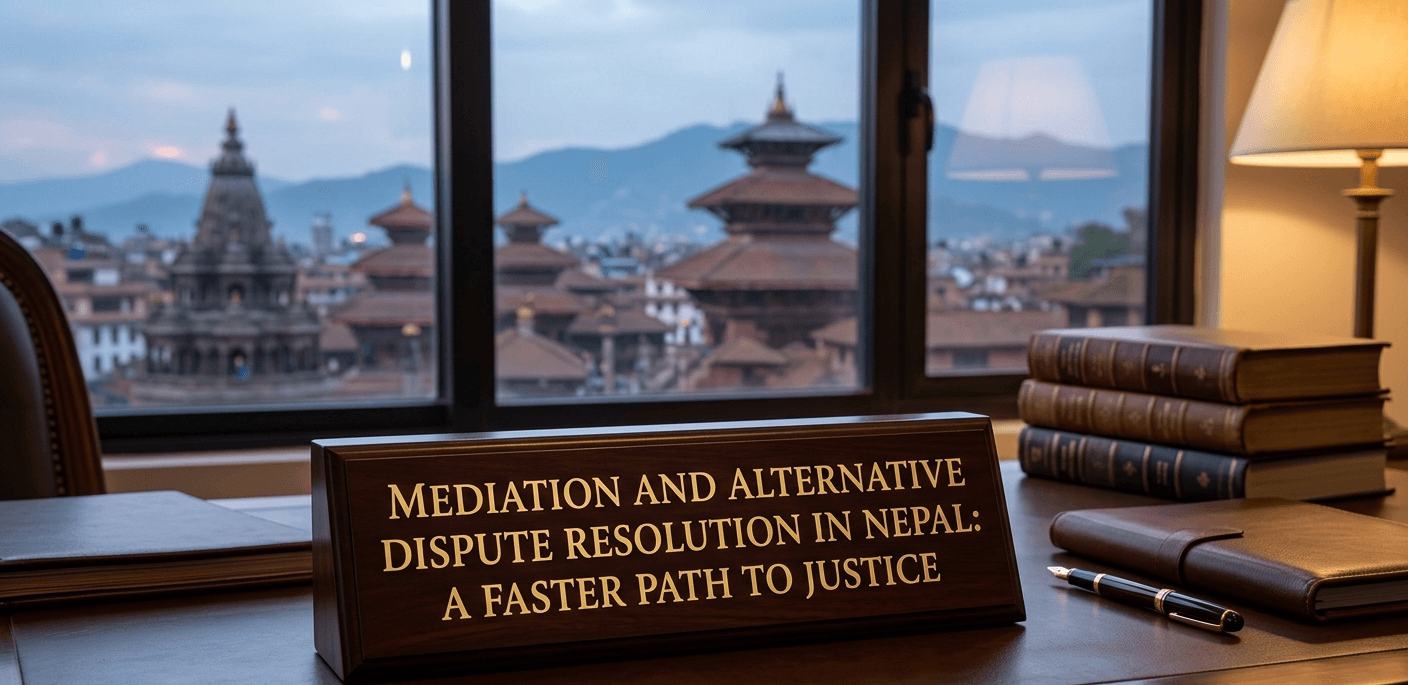
In Nepal, the traditional court system has long been the primary method for resolving disputes. However, court proceedings can often be time-consuming, costly, and complex. As a result, Alternative Dispute Resolution (ADR) mechanisms, especially mediation have gained increasing importance as faster, more accessible, and cost-effective ways to resolve conflicts.
ADR offers parties the opportunity to settle disputes outside formal court litigation, preserving relationships and reducing legal burdens. In Nepal, ADR practices are supported by laws such as the Mediation Act, 2068 (Nepal) and relevant provisions of the Muluki Civil Code, 2073 (Nepal).
This article explores how mediation and ADR work in Nepal, their benefits, legal framework, processes, and practical applications.
Alternative Dispute Resolution refers to methods of resolving disputes outside the formal court system. Instead of relying on judges, parties use neutral third parties to reach a settlement.
Common ADR methods include:
Mediation
Arbitration
Negotiation
ADR focuses on cooperation rather than confrontation.
Mediation is a voluntary process where a neutral third party called a mediator helps disputing parties reach a mutually acceptable solution.
Key features of mediation:
Voluntary participation
Confidential process
Neutral mediator
Non-binding outcome unless agreed
The mediator does not impose a decision but facilitates dialogue and understanding.
Mediation in Nepal is primarily governed by the Mediation Act, 2068 (Nepal).
This law provides:
Recognition of mediation as a legal process
Guidelines for mediator appointment
Procedures for conducting mediation
Enforcement of mediated agreements
Additionally, courts in Nepal often encourage mediation under the Muluki Civil Code, 2073 (Nepal) to reduce case backlog.
Mediation is effective for a wide range of disputes, including:
Property division
Inheritance issues
Contract disagreements
Partnership conflicts
Payment disputes
Boundary conflicts
Land ownership issues
Neighborhood conflicts
Minor civil disputes
Workplace conflicts
Termination issues
Both parties agree to resolve the dispute through mediation. This may be voluntary or recommended by a court.
A neutral mediator is selected from:
Court-approved mediators
Local mediation centers
Private professionals
The mediator:
Facilitates discussion
Identifies issues
Encourages negotiation
Helps parties explore solutions
If both parties agree:
A written settlement is prepared
It is signed by both parties
The agreement can be:
Submitted to court for approval
Enforced as a legal document
Arbitration is a formal ADR process where an arbitrator makes a binding decision. It is governed by the Arbitration Act, 2055 (Nepal).
A direct discussion between parties without third-party involvement. It is informal and flexible.
ADR processes are significantly quicker than court cases.
Lower legal fees and fewer procedural expenses.
Disputes are resolved privately.
Procedures can be tailored to the needs of parties.
Encourages cooperation and mutual understanding.
Helps reduce backlog in courts.
Not suitable for serious criminal cases
Requires willingness from both parties
Agreements may fail if not properly drafted
Limited enforceability unless formalized
Courts in Nepal actively promote ADR by:
Referring cases to mediation
Recognizing mediated settlements
Encouraging out-of-court resolution
ADR is increasingly integrated into the judicial system.
Mediation plays a vital role in:
Improving access to justice
Reducing legal delays
Promoting social harmony
Resolving disputes at community level
It is particularly effective in rural areas where court access may be limited.
Refusing mediation without consideration
Choosing an inexperienced mediator
Not documenting agreements properly
Entering mediation without preparation
Be open to compromise
Communicate clearly and respectfully
Understand your legal rights
Focus on solutions, not blame
Seek legal advice if necessary
Nepal is gradually strengthening its ADR framework. Future developments may include:
More trained mediators
Increased awareness
Institutional support for ADR
Integration with digital platforms
ADR is expected to play a major role in Nepal’s legal system.
Mediation and Alternative Dispute Resolution offer a faster, more efficient path to justice in Nepal. Supported by the Mediation Act, 2068 (Nepal) and the Muluki Civil Code, 2073 (Nepal), ADR mechanisms provide practical solutions to disputes without the delays of traditional litigation.
For individuals and businesses alike, mediation is a valuable tool for resolving conflicts while preserving relationships and minimizing costs. As Nepal continues to modernize its legal system, ADR will play an increasingly important role in ensuring accessible and efficient justice.
ADR refers to methods like mediation and arbitration used to resolve disputes outside court.
It becomes legally binding once both parties sign the agreement and it is recognized by law.
The Mediation Act, 2068 (Nepal) governs mediation.
Yes, courts often encourage or refer cases to mediation for faster resolution.